Examples
These examples show many different ways to use ProxImaL. The Basic examples section shows how to solve some common optimization problems in ProxImaL. The Advanced examples and Real-world applications sections contains more complex examples aimed at experts in convex optimization.
Basic examples
Total variation denoising
Signal distortion model:
Textual representation in ProxImaL:
prob = Problem(
    sum_squares(u - b / 255) + .1 * norm1(grad(u)) + nonneg(u))
Example code: https://github.com/comp-imaging/ProxImaL/blob/master/proximal/examples/basic_denoise.py
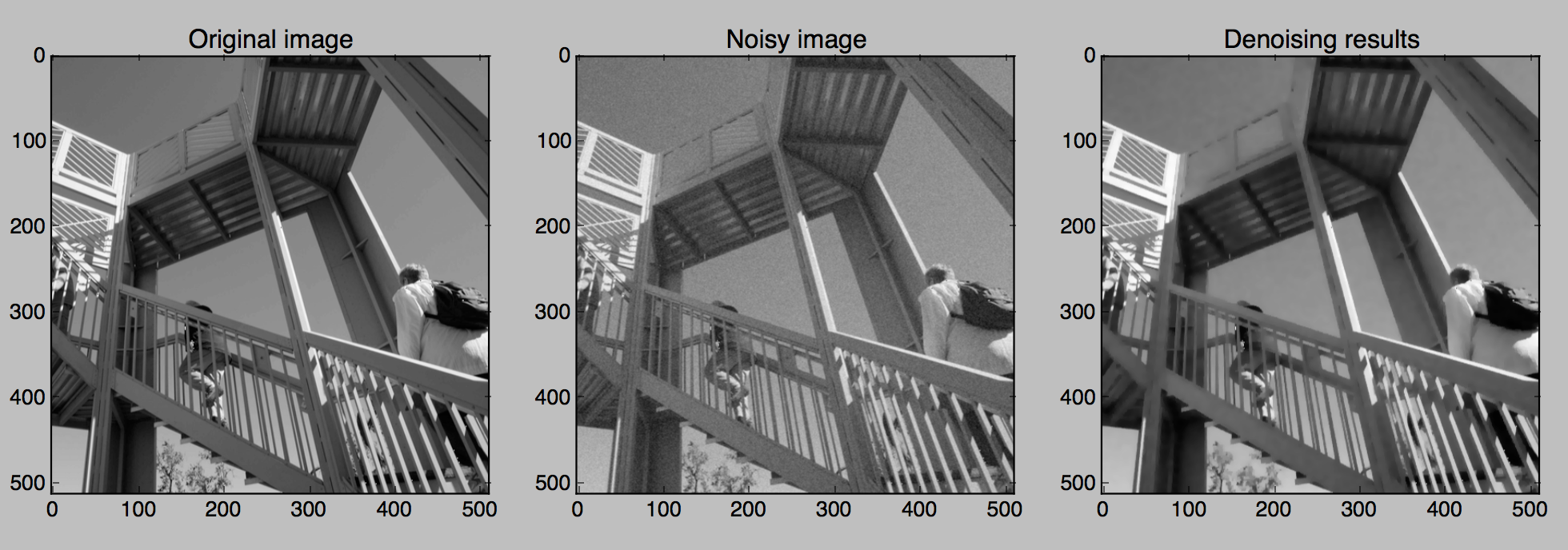
Expected output:
TV-regularized image deconvolution
Signal distortion model:
Textual representation in ProxImaL:
prob = Problem(
    sum_squares(conv(K, u, dims=2) - b) +
    lambda_tv * group_norm1(grad(u, dims=2), [2]),
)
Example code: https://github.com/comp-imaging/ProxImaL/blob/master/proximal/examples/test_deconv.py
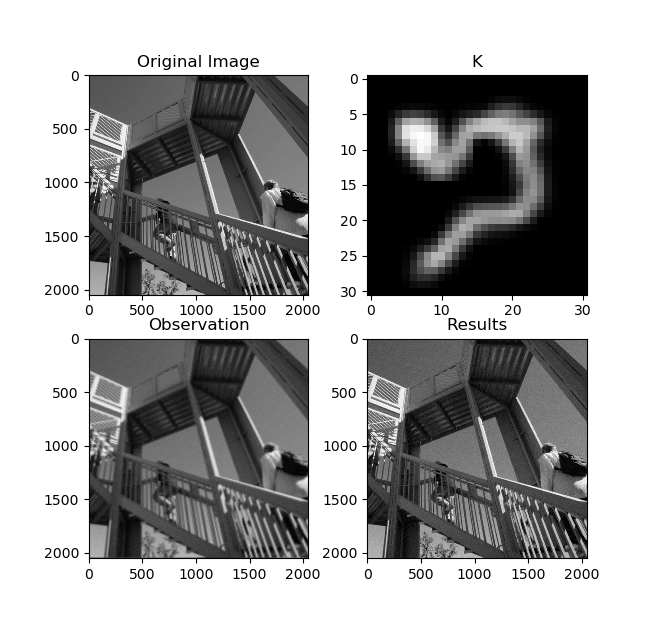
Expected output:
Total variation denoising with multiplicative Poisson noise
Signal distortion model:
Textual representation in ProxImaL:
prob = Problem([
    poisson_norm(conv(K, u), b),
    lambda_tv * group_norm1(grad(u, dims=2), [2])
])
Example code: https://github.com/comp-imaging/ProxImaL/blob/master/proximal/examples/test_poisson.py
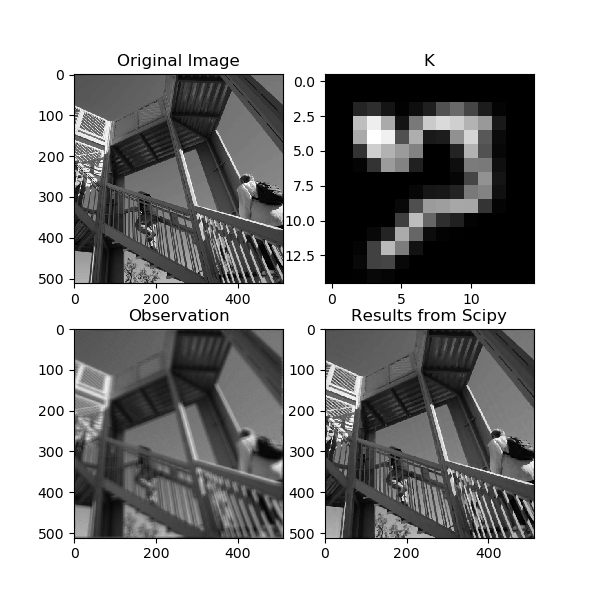
Expected output:
Advanced examples
Horn-Schunck optical flow algorithm
Signal distortion model:
Textual representation in ProxImaL:
prob = px.Problem([
    alpha * px.sum_squares(px.grad(u)),
    alpha * px.sum_squares(px.grad(v)),
    px.sum_squares(px.mul_elemwise(fx, u) + px.mul_elemwise(fy, v) + ft,),
])
Example code: https://github.com/comp-imaging/ProxImaL/blob/master/proximal/examples/test_optical_flow.py
Expected output:
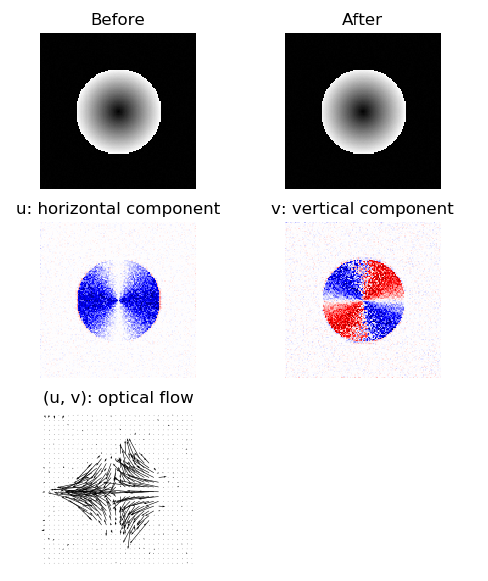
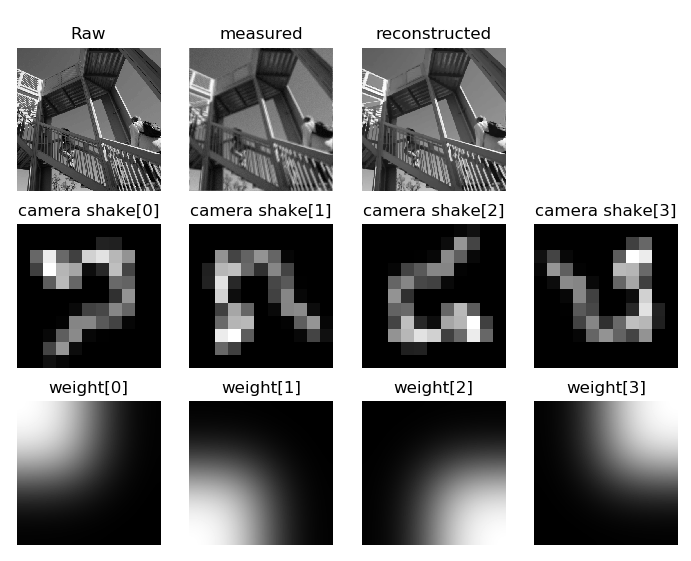
Image deconvolution with spatial varying point spread functions (SV-PSFs)
References: Denis, L., Thiébaut, E., Soulez, F. et al. Fast Approximations of Shift-Variant Blur. Int J Comput Vis 115, 253–278 (2015). https://doi.org/10.1007/s11263-015-0817-x
Signal distortion model:
Textual representation in ProxImaL:
grad_term = grad(u)

prob = Problem([
    sum_squares(
        sum([
            conv(psf_modes[..., i], mul_elemwise(weights[..., i], u))
            for i in range(n_psf)
        ]) - raw_image
    ),
    lambda_tv * alpha * group_norm1(grad_term, group_dims=[2]),
    lambda_tv * (1.0 - alpha) * sum_squares(grad_term),
])
Example code: https://github.com/comp-imaging/ProxImaL/blob/master/proximal/examples/test_deconv_sv_psf.py
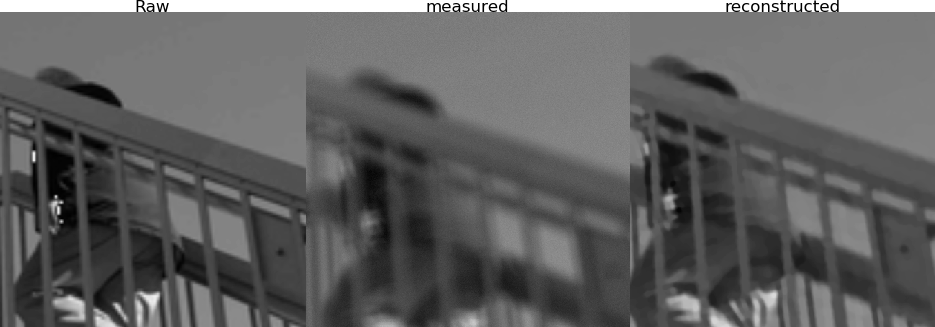
Expected output:
Joint image super-resolution and phase retrieval with Fourier Ptychographic microscopy (FPM)
References:
Problem formulation for weak phase objects: Y. Huang, A.C.S. Chan, A. Pan, and C. Yang, “Memory-efficient, Global Phase-retrieval of Fourier Ptychography with Alternating Direction Method,” in Imaging and Applied Optics 2019 (COSI, IS, MATH, pcAOP), OSA Technical Digest (Optica Publishing Group, 2019), paper CTu4C.2. https://doi.org/10.1364/COSI.2019.CTu4C.2
Derivation of the proximal operator of the complex-valued Poisson norm: Hanfei Yan 2020 New J. Phys. 22 023035. https://doi.org/10.1088/1367-2630/ab704e
Imaging instrument specifications and the lens calibration method: A.C.S. Chan, J Kim, A Pan, H Xu, D Nojima, C Hale, S Wang, C Yang, “Parallel Fourier ptychographic microscopy for high-throughput screening with 96 cameras (96 Eyes)” Scientific Reports 9, 11114 (2019). http://dx.doi.org/10.1038/s41598-019-47146-z
Raw data: https://academictorrents.com/details/c95c06e98a74a580ccbcceafdc1188ea144021c8
Signal distortion model:
Textual representation in ProxImaL:
problem = Problem(
    weighted_poisson_phase_norm(
        bayer_mask_green_channel,
        ptychography(u) * sqrt(1e3),
        simulated_lowres * 1e3,
    ) +
    sum_squares(u - 1.0) * 0.07 +
    nonneg(u),
)
Example code: https://github.com/comp-imaging/ProxImaL/blob/master/proximal/examples/fourier-ptychography.py
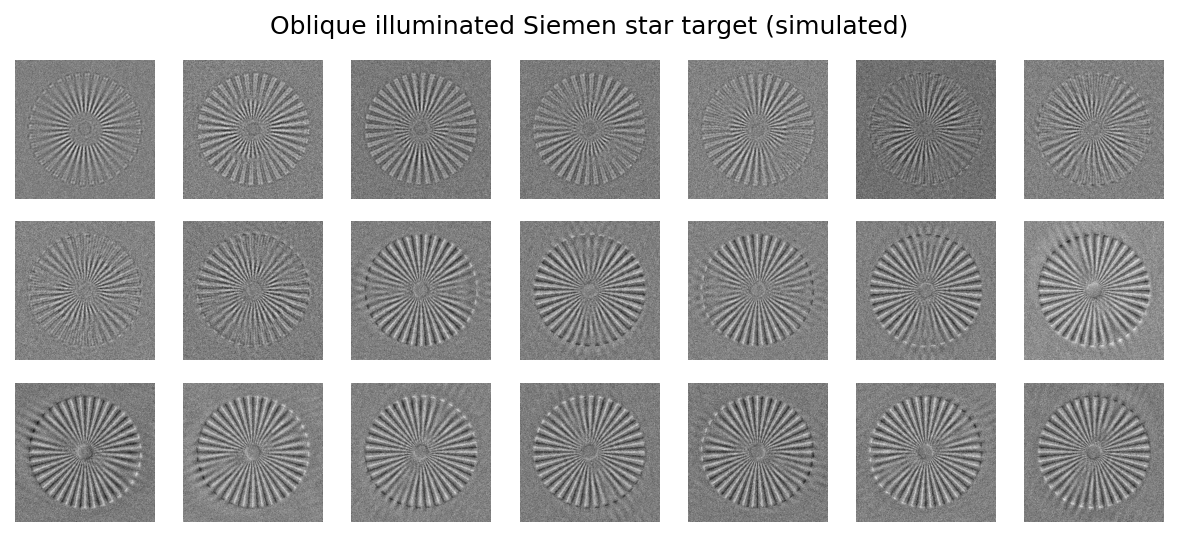
Oblique illuminated Siemen star resolution target (simulated):
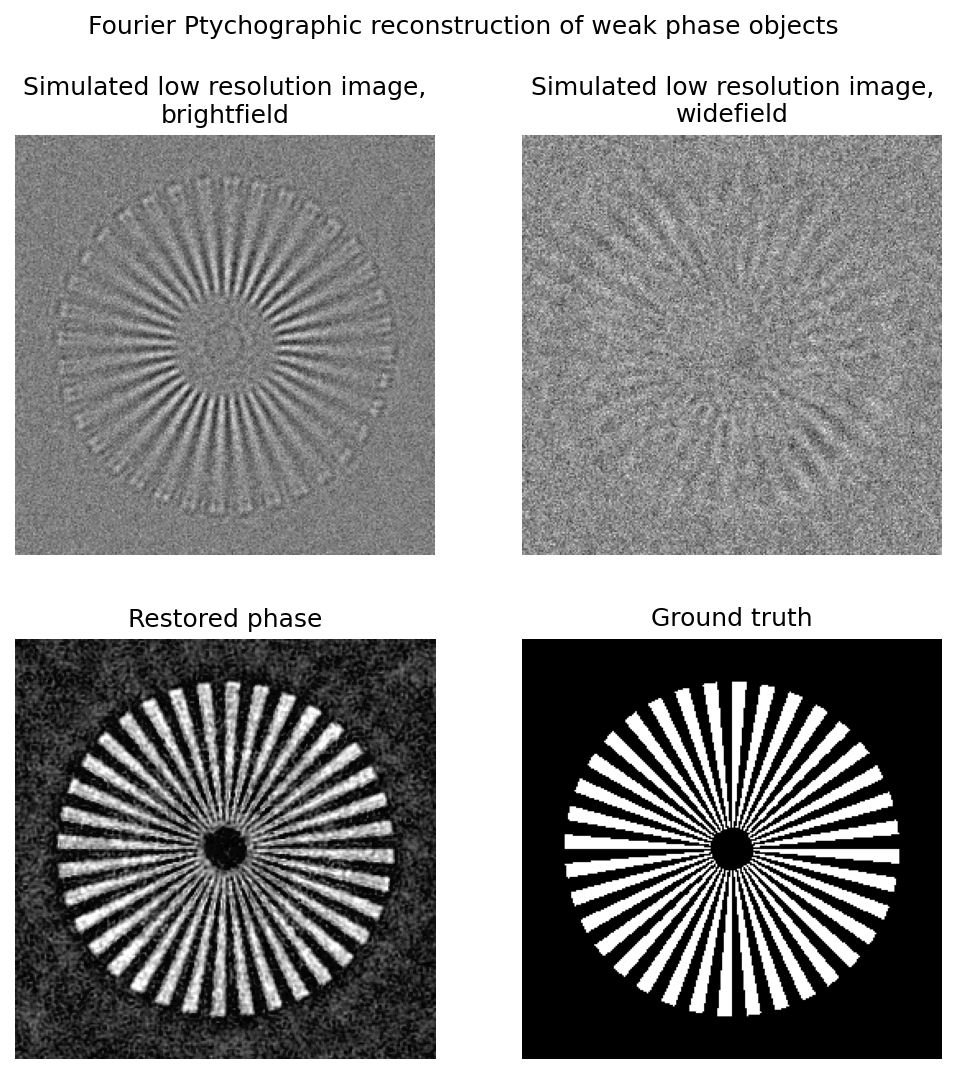
Fourier ptychographic phase retrieval results, compared to ground truth.
Real-world applications
Ptychographical phase retrieval for remote sensing;
Fourier ptychographic microscopy (FPM) for stain-free biological cell culture;
Bayer filter de-interleaving of raw pixels from CMOS image sensors;
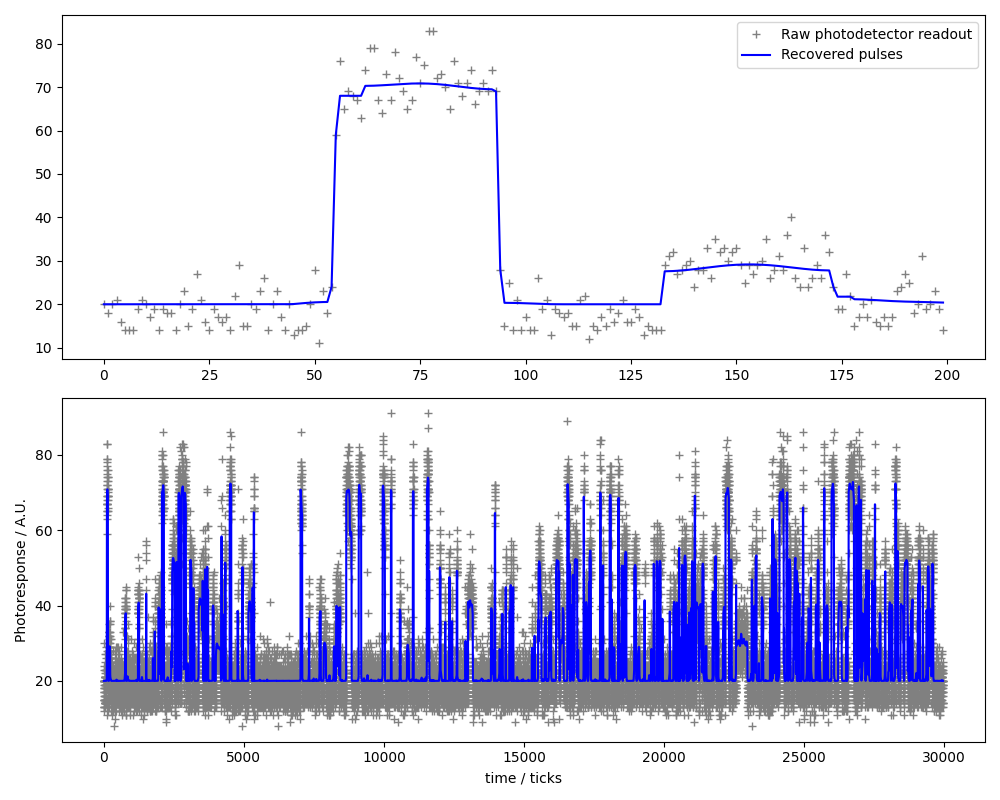
Pulse calling of single-molecule events
Reference: Brian D. Reed et al., Real-time dynamic single-molecule protein sequencing on an integrated semiconductor device. Science 378, 186-192(2022). DOI: https://doi.org/10.1126/science.abo7651
Subset of raw data retrieved on July 16, 2023, from https://zenodo.org/records/6789017 .
Warning
The original pulse-recovery method was designed for a streaming processor architecture, likely optimized for reconfigurable hardware having fixed-point arithmetic such as FPGAs. The convex-optimization approach implemented here instead processes data in batches of roughly 30,000 samples and is better suited to GPU execution having single/half-precision floating point arithmetic. Batch-based processing may introduce boundary artifacts, reflecting a trade-off inherent to this non-streaming formulation.
Signal distortion model:
Textual representation in ProxImaL:
prob = Problem(
    sum_squares(u - (b - 20.0) / 255.0) + 0.4 * norm1(grad(u)) + nonneg(u))
Example code: https://github.com/comp-imaging/ProxImaL/blob/master/proximal/examples/test_pulse_calling.py
Expected output:
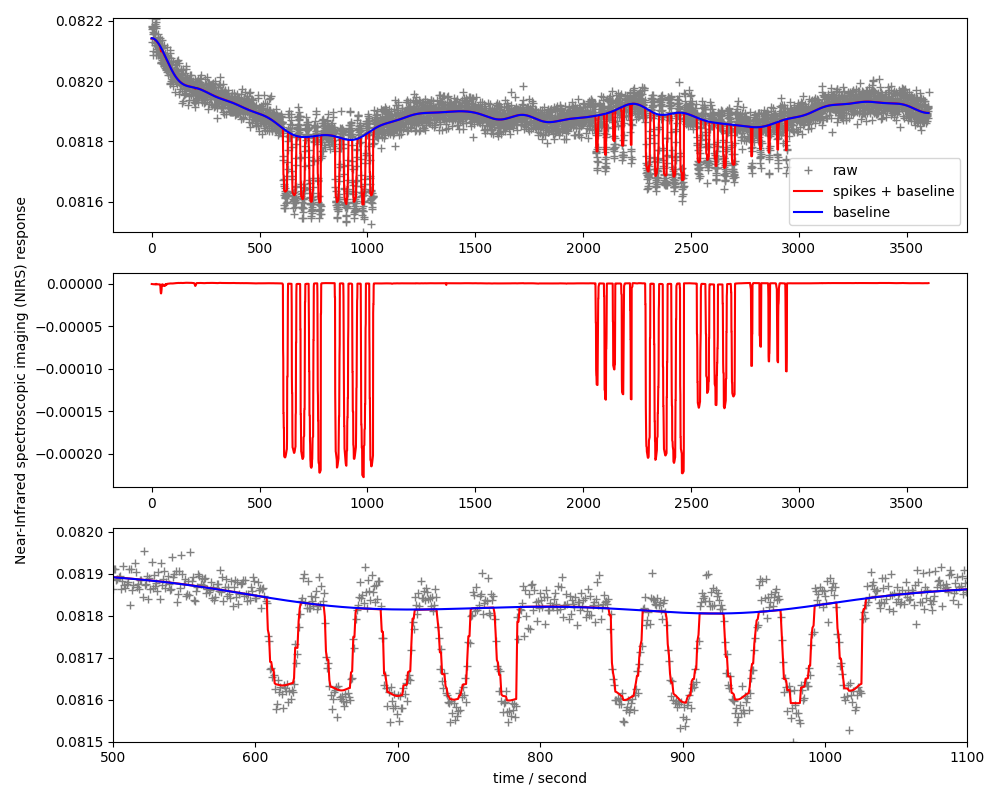
Spike-baseline signal separation of time-lapse signals
Reference: I. W. Selesnick, H. L. Graber, D. S. Pfeil and R. L. Barbour, “Simultaneous Low-Pass Filtering and Total Variation Denoising,” in IEEE Transactions on Signal Processing, vol. 62, no. 5, pp. 1109-1124, March1, 2014, https://doi.org/10.1109/TSP.2014.2298836
Signal distortion model:
Textual representation in ProxImaL:
prob = Problem([
        sum_squares(idct_op(baseline) - spikes - measurement),
        0.16 * norm1(grad(spikes)),
        0.04 * norm1(spikes),
        nonneg(u),
])
Example code: https://github.com/comp-imaging/ProxImaL/blob/master/proximal/examples/near-infrared-spectroscopic-imaging.py
Expected output:
Pixel super-resolution of oil emulsion droplets under high-speed camera
References: A.C.S. Chan, H.C. Ng, S.C.V. Bogaraju, H.K.H. So, E.Y. Lam, and K.K. Tsia, “All-passive pixel super-resolution of time-stretch imaging,” Scientific Reports, vol. 7, no. 44608, 2017. DOI: http://dx.doi.org/10.1038/srep44608.
Note
The original pixel super-resolution algorithm is meant for a streaming processor architecture, likely optimized for reconfigurable hardware having fixed-point arithmetic such as FPGAs. The convex-optimization approach implemented here instead processes data in batches of roughly 1000 raster scan lines, and is better suited to GPU execution having single/half-precision floating point arithmetic. Batch-based processing may introduce boundary artifacts, reflecting a trade-off inherent to this non-streaming formulation.
Refer to the following article for the baremetal FPGA implementation: Shi R, Wong JSJ, Lam EY, Tsia KK, So HK. A Real-Time Coprime Line Scan Super-Resolution System for Ultra-Fast Microscopy. IEEE Trans Biomed Circuits Syst. 2019 Aug;13(4):781-792. doi: https://doi.org/10.1109/TBCAS.2019.2914946.
Raw data: http://academictorrents.com/details/a8d14f22c9ce1cc59c9f480df5deb0f7e94861f4
Signal distortion model:
Textual representation in ProxImaL:
prob = Problem(
    sum_squares(
        mul_elemwise(
            mask,
            warp(
                pad(u + u_0, b.shape),
                M,
            ) - b,
        )
    ) +
    5e-3 * group_norm1(grad(u), group_dims=[2]),
)
Example code: https://github.com/comp-imaging/ProxImaL/blob/master/proximal/examples/test_pixel_sr.py
Warning
Illumination background extraction for u_0 via the one-dimensional
Pixel-SR method (aka the equivalent time sampling method),
is omitted here for the sake of demonstration.
Expected output:
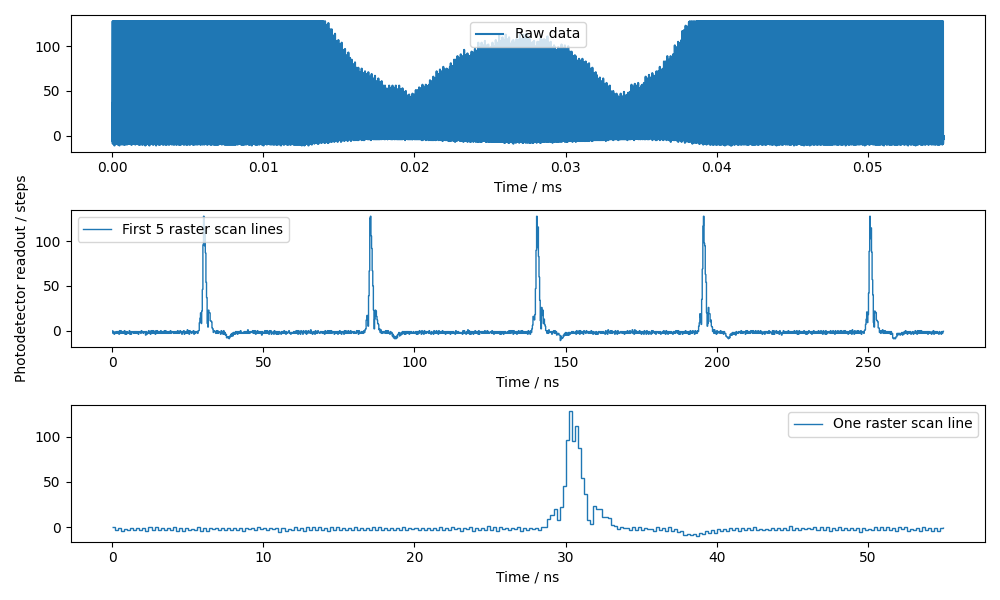
Raster scan lines captured and digitized at 5 Giga-Sample/second.
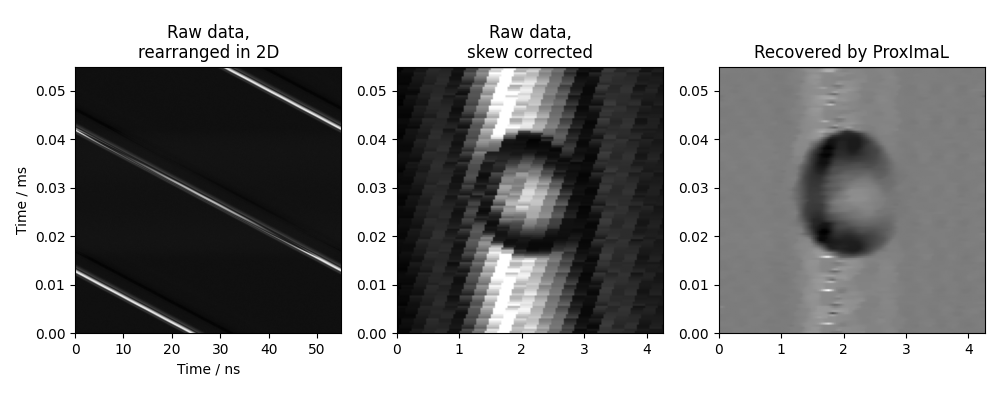
Reconstructed oil emulsion droplets in the microfluidic channel, at the linear velocity of 0.3 meter/second and a droplet generation rate of 5,800 Droplet/s.